
No products in the cart.
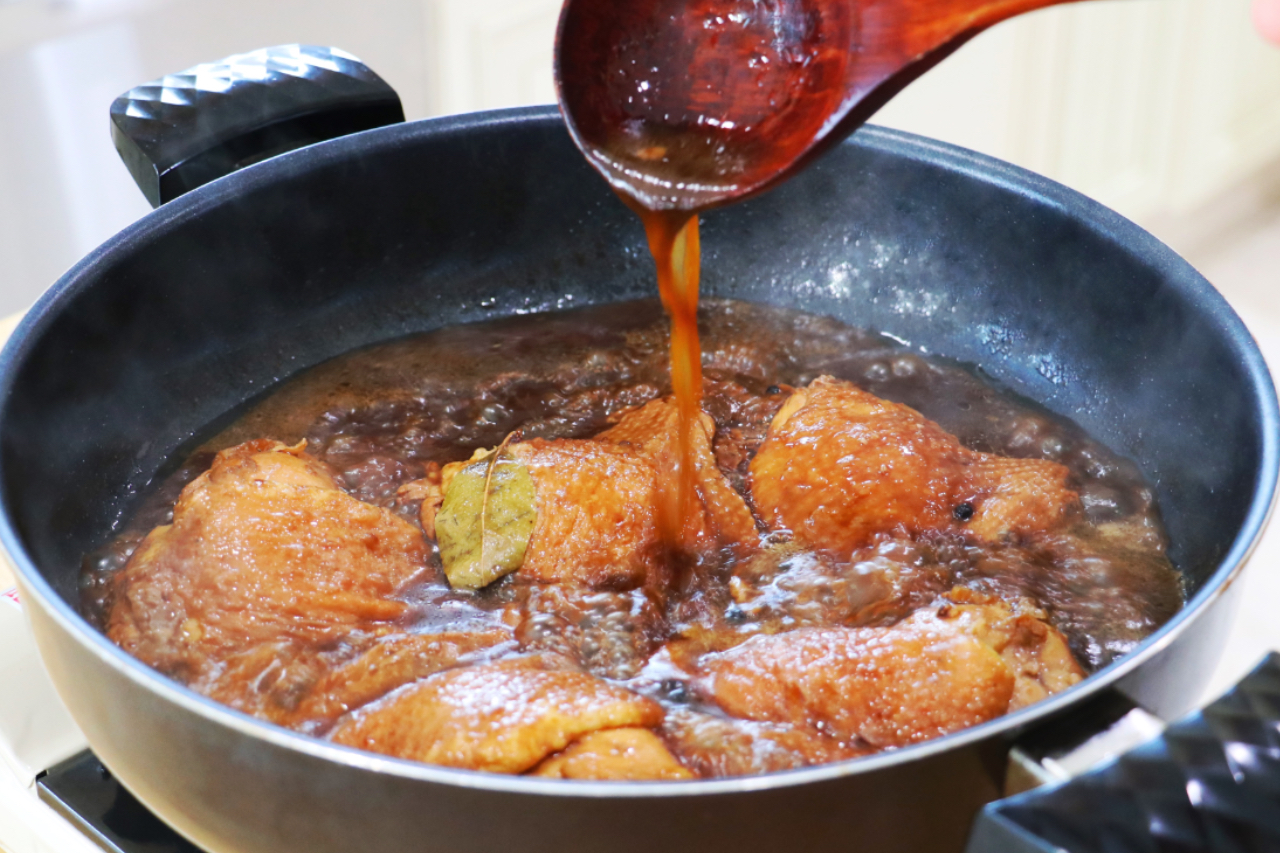
Filipino Chicken Adobo Recipe
Filipino Chicken Adobo is simple, comforting, and full of flavor—tender chicken simmered in a savory, slightly tangy sauce that’s perfect with a bowl of rice.
I was first introduced to chicken adobo by a college friend, and I still remember how simple it looked but how much flavor it had. The chicken was tender, the sauce was rich but balanced, and it was something you could keep going back to without getting tired of it.
Adobo is a dish that everyone seems to make a little differently, and there’s often a friendly debate about what the “right” version is. Over time, I started making it at home and found a version that works really well for me—simple, reliable, and full of flavor, and one my family always enjoys.
In this recipe, I’ll show you how I make chicken adobo at home, with just a few key techniques to get that balance just right.
What Is Chicken Adobo?
Chicken adobo is one of the most well-known Filipino dishes and is often considered the national dish of the Philippines.
It’s made by braising chicken in vinegar, garlic, peppercorns, and bay leaves, often with soy sauce added for depth and color. The combination creates a sauce that’s savory, tangy, and deeply flavorful.
What makes adobo special is the cooking method. The chicken is slowly simmered, allowing the sauce to reduce and the flavors to deepen over time.
There are many variations across regions and families—some use more vinegar, some add a little sweetness, and some versions don’t use soy sauce at all—but the heart of the dish always comes down to vinegar, garlic, and slow cooking.
What Does Chicken Adobo Taste Like?
Chicken adobo has a bold but balanced flavor.
It’s savory from the soy sauce, slightly tangy from the vinegar, and rich from the garlic and slow cooking. The sauce is not overly sour—it becomes smoother and more rounded as it simmers.
It’s the kind of dish that feels comforting and satisfying, especially when served with rice.
Why Don’t Stir the Vinegar?
When you first add the vinegar, it’s best to let it simmer without stirring.
This allows the vinegar to cook off slightly and mellow out, so the sauce doesn’t taste too sharp or harsh. After a few minutes, you can gently mix everything together.
It’s a small step, but it helps create a smoother, more balanced flavor.
Do You Need to Marinate?
Marinating helps the flavor soak into the chicken, but it’s not required.
You can cook the dish right away and still get a great result, since the braising process builds plenty of flavor. If you have time, letting it sit longer will deepen the taste even more.
How to Balance the Flavor
Getting the right balance is key to a good adobo.
If the sauce tastes too sour, let it simmer a little longer or add a bit of water to soften the acidity.
If it’s too salty, add water to balance it out.
If the flavor feels too sharp, it usually just needs more time to cook and come together.
If needed, you can add a small pinch of sugar to gently round out the flavor—but just a little, so it doesn’t become sweet.
Does Chicken Adobo Taste Better the Next Day?
Yes, it often tastes even better the next day.
As it sits, the flavors continue to develop and become more balanced. The sauce deepens, and the chicken absorbs even more flavor.
This makes it a great dish for meal prep or leftovers.
Variations of Chicken Adobo
There are many ways to make adobo, depending on preference and region.
Pork Adobo
Made with pork instead of chicken, giving a richer and more savory flavor.
Chicken and Pork Adobo
A combination of both for added depth and texture.
Dry Adobo (Adobong Tuyo)
Cooked longer until the sauce reduces and lightly coats the meat.
Adobo with Coconut Milk (Adobo sa Gata)
A creamier version with a slightly richer taste.
Garlic-Forward Adobo
Uses extra garlic for a stronger, more aromatic flavor.
Lighter Adobo
Uses less soy sauce and more water for a milder taste.
Storage & Make-Ahead Tips
Chicken adobo stores very well and is perfect for making ahead.
You can keep it in the refrigerator for a few days, and the flavor will continue to develop over time.
It also reheats easily on the stove, making it a convenient option for busy days.
Let’s Talk Ingredients
This dish is simple, but each ingredient plays an important role in building that signature adobo flavor.
Chicken thighs are ideal here. They stay juicy and tender during braising, and the bone adds extra flavor to the sauce.
Vinegar is what gives adobo its tang. Filipino white cane vinegar is traditional and has a clean, slightly mellow acidity, but other mild vinegars can work as well.
Soy sauce brings saltiness and depth. It balances the vinegar and helps create that rich, savory base.
Garlic is used generously and becomes soft and fragrant as it cooks, adding a lot of flavor to the sauce.
Black peppercorns add a gentle heat and a subtle spice that builds over time.
Bay leaves give the dish a warm, slightly herbal aroma that ties everything together.
Water helps balance the sauce so it’s not too strong and allows the chicken to braise gently.
Cooking oil is used at the beginning to lightly brown the chicken, adding another layer of flavor.
Step-by-Step: Let’s Cook
Serves: 4
Prep time: 5 minutes
Marinate time: 1 hour to overnight
Cook time: 1 hour
Step 1: Marinate the chicken
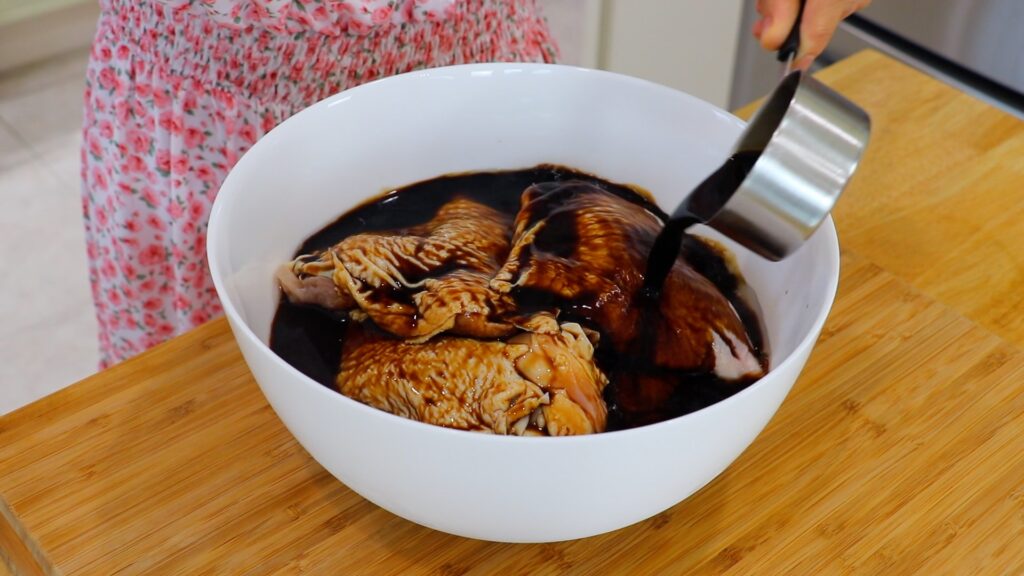
In a bowl, combine the chicken thighs, vinegar, soy sauce, and garlic. Mix well and let marinate for at least 1 hour, or overnight for a deeper flavor.
Tip: Longer marinating helps the flavor soak into the chicken more fully.
Step 2: Pan-fry the chicken
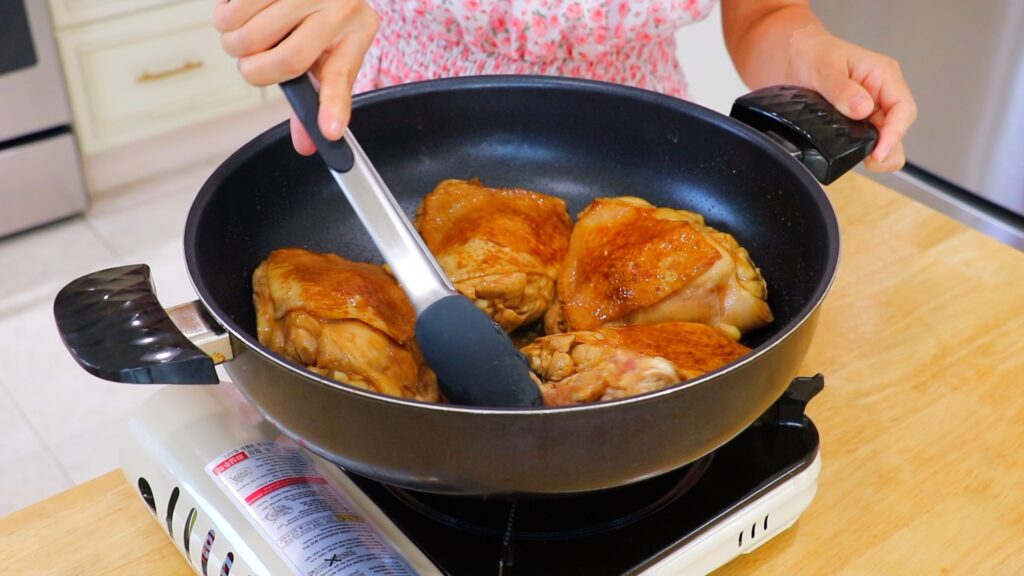
In a pot over high heat, add the cooking oil. Add the chicken (reserve the marinade) and pan-fry until lightly browned on both sides, about 5 minutes total.
Tip: Browning the chicken first builds flavor and gives the sauce more depth.
Step 3: Braise the chicken
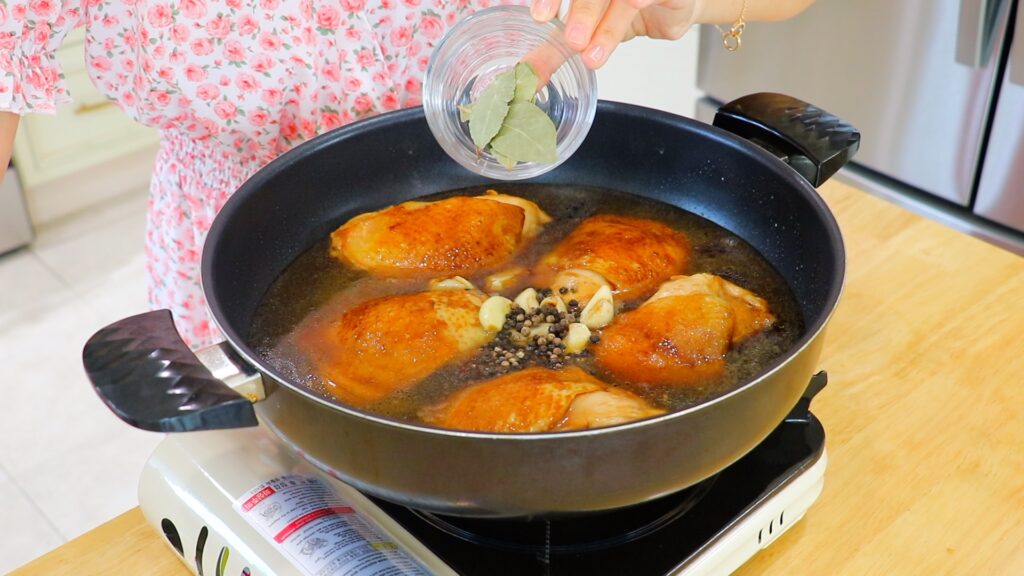
Pour in the reserved marinade, then add the water, black peppercorns, and bay leaves. Bring to a simmer and let it cook without stirring for a few minutes.
Tip: Letting the vinegar simmer first helps mellow the acidity and creates a smoother flavor.
Step 4: Simmer gently
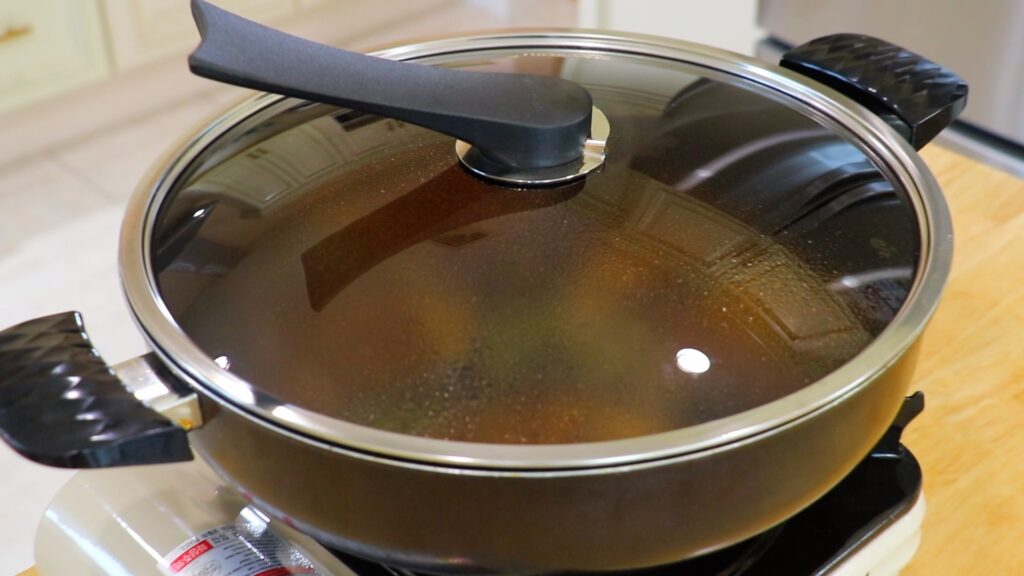
Reduce the heat to medium-low, cover, and let it cook for about 45 minutes until the chicken is tender and cooked through.
Tip: A gentle simmer keeps the chicken juicy and allows the flavors to develop.
Step 5: Reduce and serve
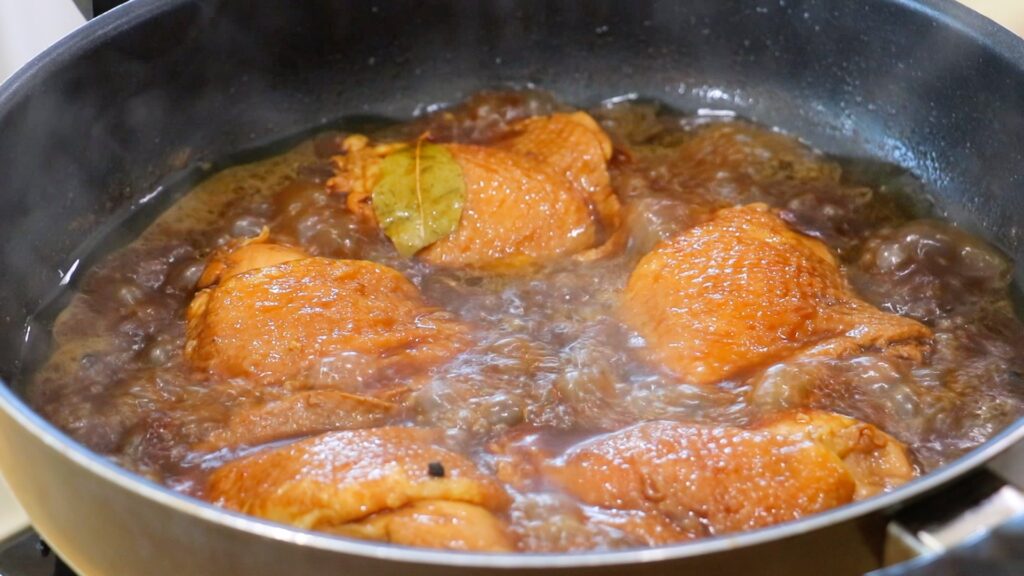
Remove the lid and let the sauce simmer for about 5 minutes, or until it reaches your desired thickness.
Make sure the chicken reaches an internal temperature of 165°F (74°C), then serve hot with plenty of sauce.
Tip: Reducing the sauce concentrates the flavor, and spooning it over rice brings everything together.
Filipino Chicken Adobo Recipe
Filipino Chicken Adobo is a classic dish with tender chicken braised in a savory, tangy garlic vinegar soy sauce.
Ingredients
- 5 pieces chicken thighs bone-in, skin-on (about 3 pounds)
- ½ cup Filipino white vinegar, or distilled white vinegar
- ½ cup Filipino soy sauce, or regular soy sauce
- 12 cloves garlic, smashed
- 1 tablespoon cooking oil
- 1 cup water
- 2 teaspoons whole black peppercorns
- 4 pieces bay leaves
Instructions
- To marinate, in a bowl, combine the chicken, vinegar, soy sauce, and garlic and mix well, then marinate for at least 1 hour or overnight.
- To pan-fry, in a pot over high heat, add the cooking oil and the chicken (reserve the marinade) and cook until lightly browned on both sides.
- To braise, pour in the marinade, add the water, peppercorns, and bay leaves, bring to a simmer, and let it cook without stirring for a few minutes.
- To simmer, reduce the heat to medium-low, cover, and cook for about 45 minutes until the chicken is tender and cooked through.
- To reduce and serve, remove the lid and simmer for about 5 minutes until the sauce thickens slightly, making sure the chicken reaches 165°F (74°C), then serve hot with the sauce.
Video
Notes
Marinate for deeper flavor: Longer marinating helps the seasoning soak into the chicken.
Brown the chicken first: This adds an extra layer of flavor to the sauce.
Do not stir the vinegar right away: Letting it simmer first helps mellow the acidity.
Simmer gently: A lower heat keeps the chicken tender and juicy.
Reduce at the end: This concentrates the flavor and creates a richer sauce.
Balance if needed: If the sauce is too sour or salty, adjust with a little water, or a small pinch of sugar to round it out.
Protein swap: You can also use pork or a mix of chicken and pork.
Thanks for freely giving your recipe then let us comment if we like the recipe.
Keep it up n I will certainly try and I am sure is going to be ìyummy.
.I don’t see you as one who’s purpose of making the recipe is making lots of money but to share .
Hope you will share your Filipino roasted pork recipe. Thanks.
Hi JL, thank you so much! I truly appreciate your kind words. I love sharing recipes so everyone can enjoy them, and I hope you enjoy this one. I also really appreciate your suggestion about the roasted pork!
Hello I am making your adobo as we speak. I had a question. Can I substitute chicken broth for water??
Hope to hear from you soon. Thank you.
Hi Tricia, Yes, you can definitely use chicken broth instead of water. Enjoy cooking, and I hope it turns out delicious!
CiCi’s mention of chicken broth is great. Another substitute in place of water I have seen used is lemon-lime soda! No need to add sugar, obviously. In place of the cane vinegar also, I like to use rice vinegar.